
From Risk to Asset: Designing a Practical Data Strategy That Actually Works


How to turn data into a strategic asset that enables faster decisions, reduces uncertainty, and helps the organization move toward its goals.
Most data platforms don't fail with a big bang
they slowly degrade and lose impact.
At first, everything looks promising: dashboards are built, pipelines run, data becomes available and teams start exploring. But over time something shifts:
- definitions and ownership are unclear
- the same metric shows different numbers in different dashboards, people stop trusting data and don't use solutions
- change and decisions take longer instead of faster and feel risky
- teams start building their own logic in isolation, spreading logic across systems
Nothing is "down" or technically broken, yet the organization slowly loses control over how data is used.
In this article I outline a practical blueprint for building a data strategy that helps you take back control and turn data into an asset instead of a risk.
The Core of the Problem
It's easy to point at technology: maybe the platform isn't right, maybe we need a data lake, a new warehouse or better tooling.
But in many cases that's not the real problem.
The problem is not the tools. It’s the organization lacking a clear way to decide, own, and use data consistently.
When that happens, familiar patterns emerge: definitions diverge, ownership becomes unclear and logic spreads across dashboards, pipelines and ad hoc analysis. Data is not trusted and stops behaving like a strategic asset an starts behaving like an organizational risk.
A data strategy can help solve exactly that.
 Mike Huls
Why you need a data strategy
A data strategy connects the highest level of an organization to the most concrete decisions. It links vision to execution. This ensures that all decisions contribute to the organization's goals.
A good data strategy creates alignment across the organization. It benefits both business and IT.
- it helps ensures that data work contributes to business goals
- it gives direction for difficult decisions (e.g. database choice)
- it creates shared ownership and accountability
- it builds trust by making decisions more consistent and traceable.
What is a data strategy?
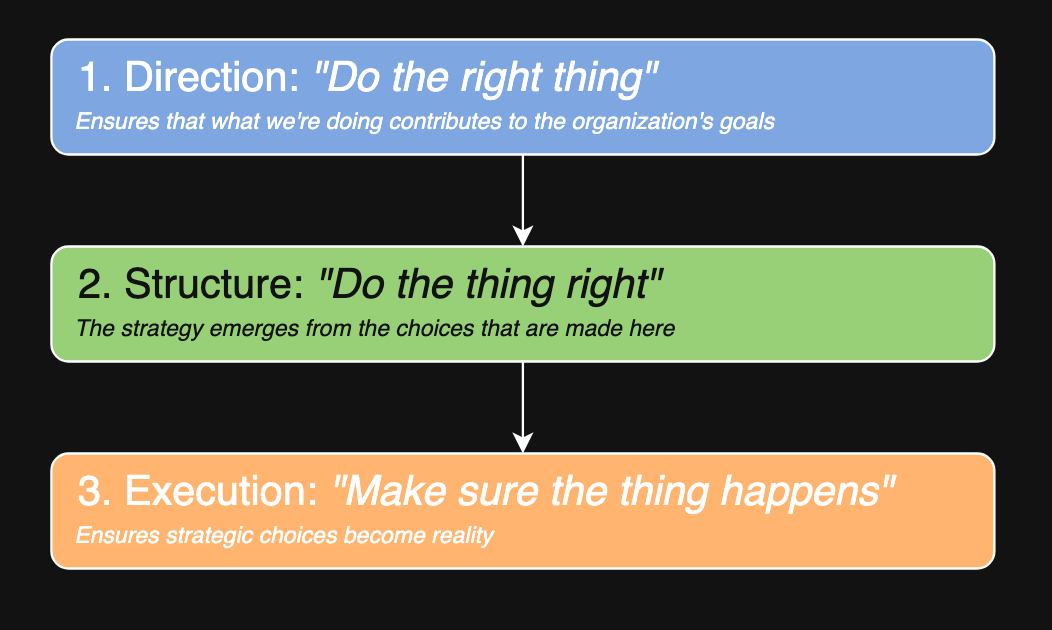
A data strategy is not a roadmap, list of tools or a collection of best practices. It is a chain that connects intention to action:
A data strategy defines how data is used to make decisions, who is accountable, and which trade-offs the organization is willing to make to make data work.
In practice, a data strategy does two things:
1 Define principles (what matters)
Think of these as the guardrails. An example could be "data is business-owned" or "definitions are shared". These should be derived from your (data) vision.
2 Define choices (what you do under constraints)
The choices are like the trade-offs you make. Do we choose strict governance or flexibility? Batch or real-time pipelines? Do we organize ownership centrally or decentralized?
The principles define the direction, the strategy emerges in the choices you make.
So a strong data strategy connects organizational direction (vision, mission) to day-to-day implementation. Many organizations skip this link step and jump straight from vision to e.g. tools. They miss an essential step in between, leading to the aforementioned problems.
 Mike Huls
Building a strategy in three components
Creating a strategy is pretty hard because it links the abstract world of vision and direction to the practical world of implementation. We'll break the data strategy into three components:
Component 1: Direction
Direction defines what you optimize for.
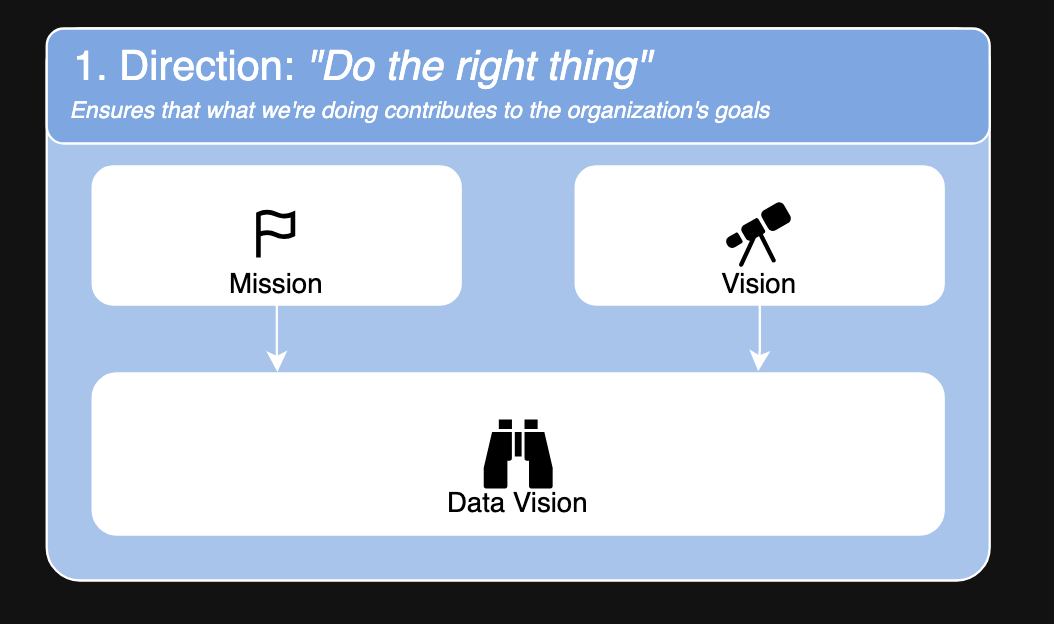
Strategy should always be grounded in the organization itself; based off of the organization's goals, vision and mission.
If your data strategy doesn’t clearly connect to your organizational vision, it’s not a strategy. It’s a collection of initiatives.
We build our data strategy on top of the data vision, which aligns with the organization's mission and vision:
Mission → Vision → Data Vision → Data Strategy → ImplementationLet's quickly go through each part.
1.1. Mission & vision (why you exist)
The mission describes why the organization exists. It's usually stable, long-term and rarely changes.
A vision describes what success looks like and where the organization is trying to go.
Example (Electric car company):
Mission: "To accelerate the world’s transition to sustainable energy"
Vision: "To create the most compelling car company of the 21st century by driving the world’s transition to electric vehicles."
1.2. Data Vision
Defines the role of data in the organization and how data supports the organization's goals. It builds the bridge between business and data.
Example (Electric car company):
"We operates with real-time, globally accessible data to enable rapid decision-making, optimize production and distribution, and accelerate market expansion."
1.3. Data strategy (how you make it happen)
Strategy translates direction into choices. The vision defines the direction, the data strategy defines the trade-offs.
This is where decisions are made about ownership, governance, structure, and operating model, guided by the data vision.
Example (electric car company)
“Because we prioritize fast, data-driven decision-making, we choose real-time pipelines over batch processing, accepting higher complexity and cost in exchange for speed and availability.”
 Mike Huls
Component 2: Structure
In this part we create a set of deliberate choices inspired by the data vision. Together, these choices form the core of the data strategy.
In the next part we'll go through each of the themes, define what they are all about, list symptoms or problems that this theme should solve and see some clear, practical examples.
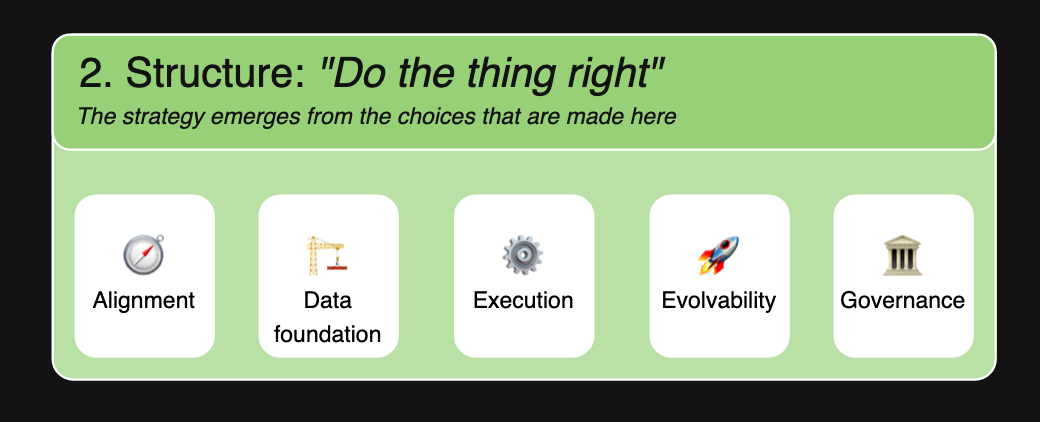
You don't necessarily need to "implement" these theme. Use them to stress-test your data strategy. Use it so see where we made explicit choices and where we're relying on assumptions.
These five themes are not the strategy itself. The strategy emerges from the choices that are made. In short:
These themes don’t define your strategy; they help you see whether you actually have one.
Explicit vs implicit choices
If certain themes are not addressed explicitly, they still exist but emerge implicitly:
- implicit governance → decisions made informally
- implicit definitions → tribal knowledge instead of shared meaning
- implicit ownership → whoever shouts the loudest
This is where thing start to break down. Problems like these are not technical, but rather the result of missing structure.
🧭 2.1 Alignment
How data connects to real decisions and business value.
This theme should consist of choices that ensure that data is tied to use cases and concrete decisions, and contributes directly to business goals. It ensures that data is used to make decisions, not just to produce information. Without this data becomes a technical exercise instead of a business asset.
What problems show up here?
- When this theme is not designed for problems like these may arise:
- dashboards exist, but nobody uses them
- teams don’t know why certain data exists
- data work is driven by IT instead of business needs
- unclear ownership of metrics and outcomes
Examples of choices that cover this theme:
- "We prioritize building data products for specific decisions, not generic datasets."
This trades higher adoption and impact for less flexibility for ad hoc analysis - "We assign ownership of data (definitions, meaning) to business domains."
Stronger accountability and relevance at the cost of less central control and standardization - "We focus on a limited number of use cases that directly impact business outcomes."
Clear ROI and focus but some use cases are delayed lower prio
🧱 2.2 Data foundation
Data cannot scale without shared meaning and consistency.
This theme covers choices that ensure that data can be used across the organization. Think about shared and documented core definitions, consistently structured data and adequate metadata that explains what data means and where it comes from.
What problems show up here?
- the same metric has multiple definitions
- teams argue about numbers instead of using them
- data is hard to understand without asking someone
- combining datasets leads to inconsistencies
Examples of choices that cover this theme:
- "We define key business concepts (e.g. revenue, customer) centrally and reuse them."
Consistency and trust at the cost of speed of change and flexibility - "We enforce consistent modeling patterns across datasets."
Easier collaboration and reuse but less freedom for teams - "We make data self-explanatory through documentation and lineage."
Easier onboarding and usage but upfront effort and maintenance.
⚙️ 2.3 Operations
Reliability and day-to-day functioning of data systems.
This theme ensures that e.g. pipelines are stable and monitored, data quality is actively managed and security and access are controlled. Without this data cannot be trusted, even if everything else is well designed.
What problems show up here?
- pipelines break or silently fail
- data quality issues go unnoticed
- numbers suddenly change without explanation
- access to data is inconsistent or insecure
Examples:
- "We build validation and testing into pipelines instead of fixing issues afterward."
higher trust and reliability but more upfront development effort - "We actively monitor pipelines and data quality."
faster issue detection but more operational overhead - "We define clear access rules for sensitive data."
Security and compliance but reduced ease of access
🚀 2.4 Evolvability
How easily does your data setup adapt to change, growth and innovation?
A data strategy should make change easier, not harder.
Data should be modular and reusable across teams and domains. We should build on existing foundations, not reinvent them. Shared meaning enables teams to combine and use data without constant translation. Without this, change is expensive, and progress slows down.
What problems show up here?
- every new use case requires rebuilding logic
- teams duplicate work across domains
- changes are slow and risky
- scaling data use becomes painful
Examples:
- "We design data models to be reused across multiple use cases."
Faster future development but more upfront design effort - "We build loosely coupled components that can evolve independently."
flexibility and scalability but increase design complexity - "We invest in shared meaning (e.g. semantic layers, ontologies)."
interoperability across teams but governance and coordination effort
🏛️ 2.5 Governance
How decisions about data are made and who is responsible.
This theme is about clearly defining ownership, explicit decision-making processes and issues that are tracked and resolved. You create structure in who owns a definition, who decides when something changes and how priorities are determined.Without governance decisions become inconsistent and issues remain unresolved.
What problems show up here?
- nobody knows who owns a dataset or definition
- changes happen without coordination
- data issues remain unresolved
- priorities are unclear
Examples:
- "We assign clear owners for data domains and definitions."
Accountability but dependency on individuals - "We define how changes to data are proposed and approved."
Consistency and control but slower decision cycles - "We track and prioritize data issues transparently."
Better prioritization and resolution but additional overhead process
 Mike Huls
Component 3: Execution
A strategy only matters if it becomes reality. This component is where we move from intention to operation.
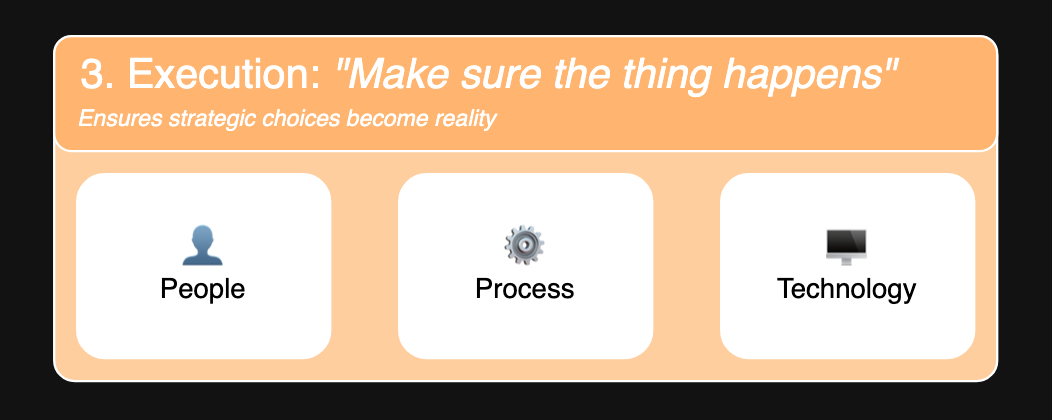
This is where many strategies fail: they look good on paper but there is no concrete implementation plan that helps us embed the strategy in how the organization actually works.
A practical way to design execution is through three dimensions:
- People → who is responsible
- Process → how it works
- Technology → what supports it
If a strategic choice is not reflected in people, process, and technology, it does not exist.
Example: business-owned data
One part of your strategy could be:
“We want data to be owned by the business.”
We make this statement real by defining what needs to actually happen in the real world; e.g:
- People → assign data owners within business domains
- Process → define ownership workflows (definition changes, issue handling, prioritization)
- Technology → enable visibility (data catalogs, lineage, access control)
Only when all three are in place does ownership actually exist.
Why this matters
Execution forces clarity. It exposes gaps such as:
- ownership without responsibility
- processes without accountability
- tools without adoption
It also reveals trade-offs like centralized vs decentralized ownership, speed vs control and flexibility vs standardization
In addition to just implementation, the execution component is also a way to validate your strategy.
For every strategic choice, you should be able to answer:
- Who owns it? (People)
- How does it work? (Process)
- What supports it? (Technology)
If one is missing, the strategy is incomplete.
 Mike Huls
Conclusion
A data strategy is a chain that connects intention to action. We've broken this down in three components:
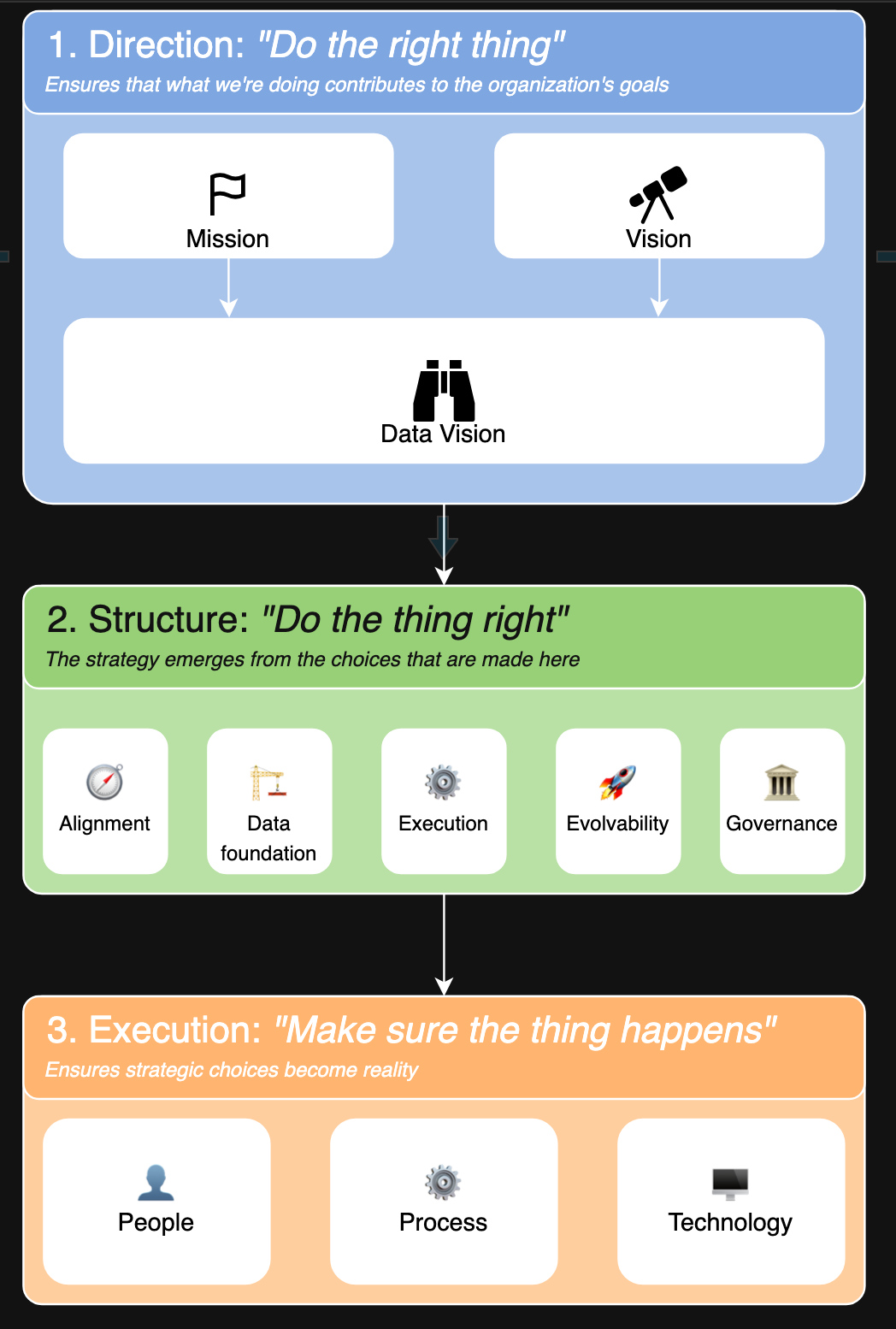
- Direction ensures that data contributes to what actually matters, without direction you build the wrong things.
- Structure ensures that the right conditions are in place. Without it, things don't scale or stay consistent.
- Execution ensures that those conditions become reality, without this nothing actually changes.
When all three components are aligned, decisions become faster, change becomes safer and trust increases.
When data behaves like an asset instead of a risk you have a data strategy that works.
I hope this article was as clear as I intended it to be but if this is not the case please let me know what I can do to clarify further. In the meantime, check out my other articles on all kinds of programming-related topics.
Happy coding!
— Mike
P.s: like what I'm doing? Follow me!


